The history of photography
From the camera obscura to advanced “point and shoot” cameras, the history of photography follows humans’ fascinating quest to capture the world around them. This quest has been fueled by dreamers, inventors and artists. Below, we take a brief look at the history of photography and the individuals who contributed to the development of this art form through the ages.
The camera obscura (500 BCE - 1600 CE)
The word photography is derived from the Greek words “photos,” which mean “light,” and “graphos,” which mean “drawing.” Modern photography traces its roots back to the invention of the camera obscura, a drawing aid used by artists and scientists to trace images using light as early as the 5th century. In its simplest form, the camera obscura projects an image through a pinhole into a dark room or box that an individual can then trace over.
Some accounts say the earliest historical mention of the camera obscura dates back to China around 500 BCE. Others say Aristotle first described the principles of the camera obscura in the 4th Century BC. Finally, there are also accounts that attribute the development of the camera obscura to an Iraqi scientist named Alhazan in the 11th century.
While the camera obscura conceptualized the beginning of photography, it should not be thought of as a modern day camera. Rather than recording images, the camera obscura simply projected them onto another surface.
Early optics and lenses (1400s - 1700s)
Following the first mentions of the camera obscura, the next stride in the history of photography occurred in the 16th century when scientist, artist and inventor, Leonardo da Vinci began sketching instructions for building a camera obscura. These instructions included the designs for simple glass lenses along with sketches for the basic pinhole apparatus.
The construction of lenses and optics followed the scientific trends of the time. Astronomers were using basic telescopes to expand their knowledge of the universe. In this way, astronomers were a driving force behind the advancement of photographic understanding and film. In fact, Johannes Kepler is credited with first coining the term “photography” as a drawing with light in 1604. At the time, he was referring to the use of telescopic optics to project an image onto a canvas to draw the stars.
Then, in 1717, German physicist, Johann Heinrich Schulze discovered that silver nitrate darkens when exposed to light. This led to further experiments in which Schulze placed stencils under light rays — first in a flask, later on paper — to produce a negative image upon the silver nitrate solution. Unfortunately, these images were not permanent, however, as Schulze could not figure out how to stop the light from continuing to darken the image to black. Schulze’s discovery became an important advancement in the development of modern photography; one which leads many sources to credit him as one of the inventors of photography. After his breakthrough, the search began for a way to capture a permanent image — not just of a stencil pattern, but of a real scene.
The first photograph (1827)
The first permanent image was taken in 1827 in Saint-Loup-de-Varennes, France by lithographer, Joseph Nicéphore Niépce. Niépce was looking for a way to transfer his drawings to his printing plates. To create it he waxed the paper of his drawings and placed them down on a plate coated with asphalt (bitumen of Judea). When the light passed through the paper, it hardened the asphalt solution. But, in the areas where his drawing ink blocked the sun’s rays, the asphalt remained soft and could be removed with a solvent to leave a negative image behind. It took at least eight hours to record the image, which shows the view from his work room in Saint-Loup-de-Varennes. You can make out a barn and some rooftops of nearby buildings. Niépce’s image is considered the earliest known photograph in the history of photography. His discovery would not have been possible without the breakthroughs of preceding inventors like Johann Heinrich Schulze and the aid of his portable camera obscura.
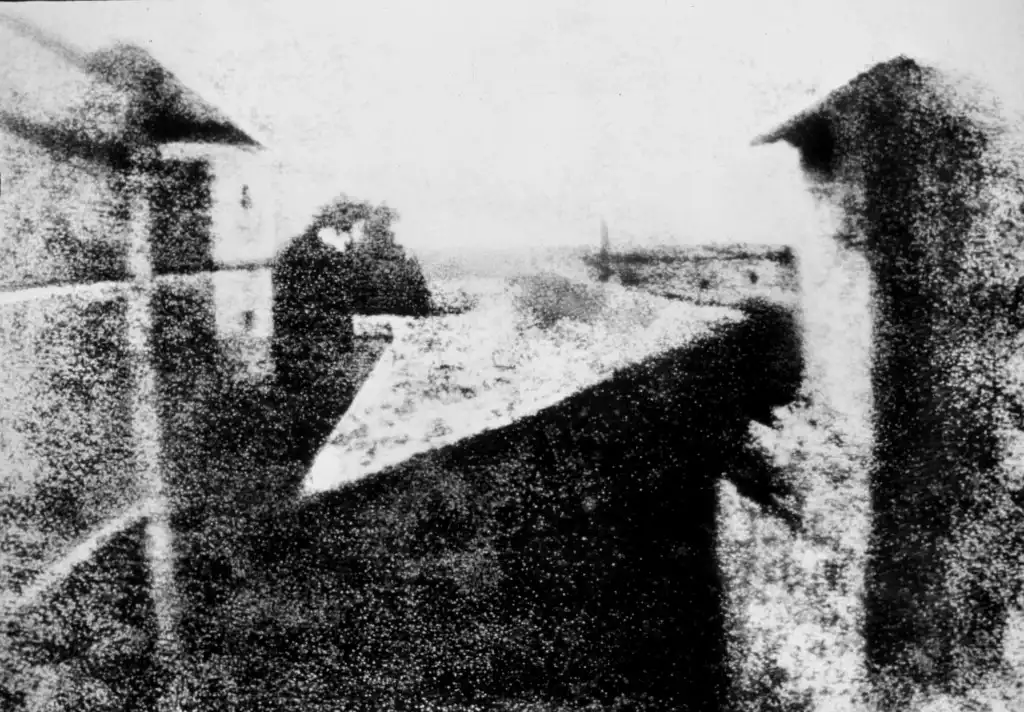
The first photograph taken by Joseph Nicéphore Niépce. Source: PhotographyTalk.com
The daguerreotype (1839)
Following Niépce’s discovery, he was approached by Louis Jacques Mandé Daguerre, a painter who had heard of his breakthrough and was very interested in its ramifications. Daguerre requested to partner with Niépce and share information about his discovery. After a few years of hesitation, Niépce assented to a business venture with Daguerre in 1829. Four years later, Niépce passed away but Daguerre continued the work of perfecting the photographic process of “daguerreotype,” a forerunner to modern film processing. To create a daguerreotype, a silver coated plate was exposed to mercury fumes, which made the plate more light sensitive than Niépce’s previous asphalt solution-based plates.
Around this time, a chemical (sodium thiosulphate) had been discovered that successfully halted the chemical reaction of the plate to incoming light (something Johann Heinrich Schulze was not able to develop in his early experiments with silver nitrate). Using this chemical, the exposed image on the plate was still invisible (known as a “latent image”), but it was "developed" by exposure to mercury fumes, which formed silver iodide on the plate’s surface. The areas that were not struck by light could then be washed away by a "fixer". Obviously the mercury fumes involved in this process were very dangerous to its early users.
Daguerre’s process was released in 1839. Not only did it improve the detail of Niépce’s early photographs but also the speed. A daguerreotype could be exposed anywhere from 15 to 40 minutes, a drastic reduction from the eight hours it took Niépce’s to expose his first photograph. Importantly, the daguerreotype enabled the commercialization of photographic portraiture. This has proved to be a critical stride in the history of photography, contributing to the medium’s access to the masses and also accelerating continued breakthroughs in the development of photographic technology.
The calotype (1839)
Just three weeks after Daguerre launched his daguerreotype process, English inventor, William Henry Fox Talbot, announced his “negative-positive” system, eventually known as the calotype photographic process.
Using this process, Talbot was able to produce a paper negative by taking a piece of paper sensitized with silver nitrate and placing it atop a blank, sensitized sheet of paper. These two papers were then sandwiched between two panes of glass and exposed to light in a camera obscura. The paper sensitized with silver nitrate became a “negative reversal” of tone. This negative image then created an opposite “positive” image on the second sheet of paper.
In contrast to the daguerreotype, Talbot’s calotype process added an additional step to create a negative image —which at the time seemed like an inefficient additional step. However, the creation of the negative enabled the efficient production of multiple prints. This ultimately became the greatest contribution of the calotype to the continued innovation of photography. Furthermore, Talbot’s calotype process radically decreased exposure times from hours and minutes to seconds.
Collodion wet plate process (1851)
As the years progressed, more advancements were made in photographic processing. In 1851 Frederick Scott Archer announced his collodion wet plate process, a method that involved coating a glass plate with a collodion solution and exposing the plate while it was still wet. The collodion wet plate process created images that were sharp like the daguerreotype and easily reproducible like the calotype. The process also dramatically reduced exposure times (around two to three seconds), was much more convenient and safer than the daguerreotype. Finally, thanks to Archer’s collodion method, street photographers were able to monetize the business of tintype portraiture, a practice that continues in some countries today.
Dry plates (1871)
A few decades later, dry plates supplanted the wet plate collodion method as an even more convenient way to process photographs. After noticing how the ether vapor of the collodion method affected his health, Richard Maddox invented the dry plate system in 1871. This method coated glass plates with gelatinized cadmium bromide and silver nitrate making them dry instead of wet. These dry plates made processing more convenient, as photographers could make and store them beforehand rather than producing them as needed. Also, rather than having to cart around heavy loads of chemicals and supplies in wagons for processing wet plates, the dry plate method gave photographers more freedom. The process also allowed for smaller cameras that could be hand-held.
The first roll of film (1889)
In 1889, George Eastman created the first roll of film, which revolutionized the practicality of taking photos. With film, photographers could shoot multiple pictures one after the other. Eastman released his invention through his company Kodak. Eastman’s flexible roll of film made snapshots possible as images no longer needed to be immediately and individually processed. Film also made it possible to create a self-contained box camera that held 100 film exposures. Rather than constantly switching plates, after taking her images, a photographer could just send the camera back to the factory for images to be developed and printed. This camera also became the first of its kind that was inexpensive enough for the everyday consumer to afford.
Shortly after Eastman launched his film innovation, Thomas Edison optimized it further. Edison cut the film down the middle and added perforated edges, creating the 35mm format that became popular later.
The 35mm camera (1925)
In 1913, German engineer Oskar Barnack invented the first Leica camera which used the small-format 35mm film developed by Thomas Edison. This camera modernized the previous bulky box camera. Not only was it more compact, smaller and lighter than previous hand-held cameras, it utilized inexpensive film. In this way, Barnack’s 35mm camera allowed a photographer to rapidly and unobtrusively make 36 exposures without reloading. While Barnack created his invention in the early 1900s, due to World War I, he was not able to release his Leica I camera to the public until 1925. When he finally did it became a phenomenal commercial success. Very quickly the 24x36mm format became one of the most produced and used image formats in all of photography and continues to be to this day.
Color film and instant photos (1930s and 1940s)
Breakthroughs and innovations continued to expand photography’s access to the everyday consumer into the 1900s. After releasing the first roll of film, George Eastman innovated the first color film. This first film with multiple layers for developing in color was called Kodachrome and was released by Kodak in 1935. Kodachrome quickly became the go-to color film for still life photography, cinematography and movies for both amateurs and professionals.
Then, in 1948, the history of photography took another exciting stride into instant photos when Edwin H. Land released his polaroid camera, called the Model 95. The Model 95 created only sepia-toned images. After the film emerged from the camera, photographers only had to wait 60 seconds before peeling off the negative backing of the image. Although the camera far from exceeded the quality of traditional films, it gave the modern photographer the ability to see their creations instantly. The camera was first launched at a department store in Boston and sold out in minutes.
35mm SLRs (1950s)
In 1957, Asahi Optical of Japan (later known as Pentax) introduced the Asahiflex, the first eye-level viewing single-lens reflex (SLR) camera with an instant return mirror. Shortly after, in 1959, Nikon released its Nikon F, a professional-caliber 35mm SLR with an intricate system of lenses, motor drives, and accessories . Both cameras innovated the SLR style and contained interchangeable lenses and other accessories. For the next 30 years, SLR-style cameras remained the camera of choice.
Digital photography (1975 - present)
While the concept of digital cameras had existed since the 1960s, the Eastman Kodak camera designed by Steven Sasson in 1975 launched the first self-contained digital camera technology. Advances in digital photography continued into the 1980s and 1990s. Several computer developers and camera manufacturers launched point and shoot style cameras during this time. Furthermore, from about 1989 through the early 2000s, Fuji and Kodak collaborated with Canon and Nikon to make digital cameras that further fit the needs of the modern photographer. In 1999, Nikon introduced the D1, which marked the first time a major camera manufacturer designed and built a camera specifically with a digital system.
Smartphones
While opinions differ, many believe the first smartphone with camera technology was either the Samsung SCH-V200 or the Sharp Electronics J-SH04 J-Phone, both released in 2000. Over time, smartphones have revolutionized the ability to capture high-quality photographs on-the-go. This has been further enhanced by apps like VSCO, that let photographers capture and edit professional-looking photographs without the need for complicated equipment or a darkroom. From the camera obscura to today’s smartphone, we’ve come a long way in the history of photography. With smartphones, people can store and record countless still images and videos and also share them with the world instantly. No longer is the art of photography relegated to only those who have the resources and knowledge to pursue it. Today, anyone with a passion for the art form and a smartphone can take part.
The history of photography timeline
500 - 1600 BCE
Camera obscura
1400s - 1700s
The development of early optics and lenses
1827
Joseph Nicéphore Niépce takes the first photograph
1839
Louis Jacques Mandé Daguerre invents the daguerreotype; Henry Fox Talbot invents the calotype.
1851
Frederick Scott Archer develops the collodion wet plate process
1871
Richard Maddox invents the dry plate process
1889
George Eastman creates the first roll of film and launches it through his company, Kodak
1925
Oskar Barnack launches the first Leica camera that uses 35mm film
1935
Kodak launches the first roll of color film called Kodachrome
1948
Edwin H. Land releases the first polaroid camera, Model 95
1957
Pentax introduces the Asahiflex, the first SLR-style camera
1975
Steven Sasson launches the first self-contained digital camera
1999
Nikon introduces the D1, the first camera developed specifically with a digital system
2000s
Smartphones and photo editing apps revolutionize the way individuals capture and edit photos