
The hardest part of becoming a full-time photographer usually isn't the decision to quit your day job.
It's knowing when your numbers, your client demand and your systems can support it. A strong portfolio and a few steady bookings are a good start.
A full-time income also depends on pricing that covers your costs, a savings cushion and workflows that hold up when you're busy.
The transition doesn't have to happen overnight.
Starting with photography as a side business gives you time to test demand, refine your services, set your pricing and build reliable systems before photography becomes your primary income.
Whether you photograph weddings, portraits, commercial campaigns or events, this guide covers how to assess your readiness, plan your finances, price your services, find clients and build a photography business that can support you full-time.
This article provides general information only and does not constitute legal, financial, tax, or investment advice. Laws and individual circumstances vary.
Key answers
Becoming a full-time photographer requires more than a strong portfolio and consistent bookings. Before transitioning from part-time to full-time photography, evaluate client demand, calculate your income needs, build financial reserves, and establish reliable systems for finding clients and managing projects. A gradual transition lets you test whether your photography business can sustainably replace your current income.
- Assess your readiness: Look for consistent paid bookings, qualified inquiries, profitable pricing, manageable workloads, and repeat clients rather than relying on one busy season.
- Calculate your income requirements: Determine how much revenue you need to cover personal expenses, business costs, taxes, and savings. Build a financial runway of three to six months of essential expenses.
- Price photography services for profitability: Account for planning, photography, editing, administration, overhead, and commercial usage rights when setting rates and packages.
- Build a consistent client pipeline: Attract photography clients through a professional portfolio, referrals, direct outreach, social media, and search visibility.
- Establish your business systems: Set up contracts, invoicing, bookkeeping, insurance, and client communication processes before making photography your primary income.
- Create scalable workflows: Standardize recurring tasks like inquiries, proposals, scheduling, editing, image delivery, and follow-ups to manage more clients without sacrificing quality.
What you'll learn in this guide:
- Assess Whether You're Ready to Become a Full-Time Photographer
- Calculate Your Income Needs and Build a Financial Runway
- Price Your Photography Services for Profitability
- Find Photography Clients and Build a Consistent Pipeline
- Establish the Foundations of Your Photography Business
- Build a Photography Workflow That Can Scale
- Put the Whole Workflow in One Place
- Make the Transition Step by Step
- Full-Time Photographer FAQs
Running a photography business involves more than taking pictures.
You'll also find clients, answer inquiries, prepare proposals, manage projects, edit images, deliver work and handle finances.
Before you commit, evaluate whether your business can support the transition.
Start by defining what success looks like for you.
You might specialize in weddings, pursue commercial assignments, or combine client work with print sales and personal projects.
Your preferred work, lifestyle and income goals shape your business model.
Use Four Readiness Indicators
Readiness isn't about hitting one arbitrary revenue number. It's about showing that your business model works repeatedly. Look at four areas:
- Demand: You consistently receive qualified inquiries and can identify where they come from. Past clients return or refer others.
- Revenue: Your average booking value and project volume can support your income goals, and your pricing covers your time, expenses and expertise.
- Capacity: You can manage photography, editing and administration without compromising delivery. A full calendar isn't necessarily a profitable one if you're always catching up.
- Resilience: You have savings, clear visibility into your finances and a plan for slower periods.
Look for consistent demand rather than social media engagement or one exciting project. Your portfolio should also reflect the style and assignments you want to attract, and your clients should be giving you positive feedback and repeat bookings.
Track Your Business Performance
Record a few key numbers each month:
- Qualified inquiries received
- Bookings confirmed
- Average booking value
- Revenue collected
- Project expenses
- Repeat clients and referrals
- Time spent on client work and on administration
Watch trends over several months instead of judging from one unusually busy period. Also separate booked, projected and collected revenue.
A photographer with $10,000 in outstanding proposals isn't in the same position as one with $10,000 in completed, paid assignments.
If your schedule is already full, try improving your pricing, refining your packages or streamlining your workflow before adding more work.
One of the biggest changes in going full-time is moving from a predictable paycheck to income that varies month to month.
A financial plan shows what your business needs to earn and how much you need saved for slower periods.
It involves three separate calculations:
- Personal income requirement: what you need to pay yourself to cover personal expenses
- Business revenue requirement: what the business must bring in to cover operating costs, owner pay, taxes and reserves
- Cash runway: how long you can cover essential expenses if bookings slow down
Calculate Your Personal Income Requirement
Start by estimating your monthly personal costs:
- Housing and utilities
- Groceries and transportation
- Health insurance, which you'll arrange yourself as a self-employed photographer
- Debt payments
- Personal savings and retirement contributions, which are also your responsibility
Then set two targets: a minimum that covers essential expenses, and a sustainable target that also lets you save, reinvest and take time off.
Calculate Your Business Revenue Requirement
Revenue isn't take-home pay. Your business revenue must cover operating costs, taxes and reserves before you decide what you can pay yourself.
Use this planning formula:
Monthly revenue target = owner pay + business costs + tax reserve + profit and reserves
Business costs include equipment maintenance and replacement, editing software, website hosting, marketing, studio rental or travel, insurance and professional services.
The formula is a planning framework, not a tax calculation. Your actual amounts depend on your business structure and circumstances.
Build a Financial Runway
A runway is the savings you can draw on when business income is inconsistent. A common starting point is three to six months of essential personal and business expenses.
Consider more if your work is seasonal, your bookings fluctuate or you have significant financial commitments.
Here is a hypothetical example. If your essential personal expenses are $3,500 a month and your business overhead is $600, you need about $4,100 a month. A six-month runway is $4,100 × 6 = $24,600.
Notice that the runway is not the same as the income the business needs to generate. It only covers essentials while bookings are slow.
Keep it separate from your operating funds so you aren't dipping into emergency savings for routine costs.
Set Up a System for Managing Income
- Keep business and personal finances separate
- Set aside money for taxes as payments arrive
- Track outstanding invoices and upcoming expenses
- Allocate funds for equipment, operating costs and emergencies
- Pay yourself consistently when cash flow allows
- Hold off on major purchases until revenue is stable
A cash-flow forecast helps you anticipate when payments arrive and when expenses are due.
Projecting 6 to 12 months ahead shows you slower periods before they hit.
Review it regularly, especially before a major purchase.
Pricing is about more than choosing an hourly rate or matching what other photographers charge.
A single assignment might include a consultation, creative planning, travel, equipment preparation, the session, culling, editing, revisions and delivery.
If you only charge for the time behind the camera, you're likely overlooking a large share of your work.
Calculate Your Required Average Booking Value
Work backward from your revenue target. Divide it by the number of projects you can realistically deliver each month.
Here is a hypothetical monthly model:
- Owner pay: $5,000
- Business operating costs: $1,000
- Tax reserve: $1,500
- Profit and additional reserves: $500
- Monthly revenue target: $8,000
If you can comfortably deliver eight projects a month, $8,000 ÷ 8 = $1,000. That's the average booking value you need to meet the target.
These figures are for explaining the calculation, not industry benchmarks or recommended rates, and the tax reserve is illustrative.
Account for the Full Cost of Each Project
Total the time each project takes, including client communication, planning, travel, production, editing, revisions and delivery. Then add:
- Travel, equipment and production expenses
- Image licensing and usage rights for commercial projects
- Storage, delivery and administrative work
- The experience and creative expertise you bring
Track the time and expenses of finished projects to see which services are profitable and which need repricing. Competitors' rates can be a useful reference, but calculate your own costs first.
For commercial work, fees should also reflect how, where and for how long images are used. More guidance on building a long-term career in commercial photography goes deeper on pricing and repeat clients.
Develop Clear Packages
Packages help clients understand what they're buying.
Depending on your specialty, you might vary coverage length, image collections, licensing, prints or add-ons.
If a prospect has a limited budget, adjust the scope instead of automatically lowering your rate, and review your pricing as demand, experience and expenses change.
A full-time photography business needs a reliable way to attract new clients.
Referrals and social media help, but relying on one source leaves you exposed to changing algorithms and seasonal demand.
Start by identifying your specialty, your audience and your value: the type of photography you want to be known for, who hires for it, and why your approach and services fit them.
If you're still deciding, this guide on how to choose a photography niche and build a portfolio that attracts clients can help.
Follow a Simple Client Acquisition Cycle
- Get discovered: make your work visible through your portfolio, search, social platforms, professional networks and referrals
- Build confidence: show complete projects, explain your services and make your approach clear
- Convert inquiries: respond promptly, understand the brief, present a clear proposal and follow up
- Build relationships: deliver a strong experience, request testimonials and stay in touch with past clients
Then measure it.
How many qualified inquiries do you receive, and how many become bookings?
Which channels bring the best clients?
What is your average booking value?
How many clients return or refer someone?
Those answers turn marketing from an activity into something you can improve.
Build a Photography Portfolio That Attracts Clients
Your portfolio is often the first place prospective clients evaluate your work.
Choose cohesive images that reflect the assignments you want to book, organize them into projects so visitors see how you approach a whole assignment, and include a concise introduction, clear services and an easy way to contact you.
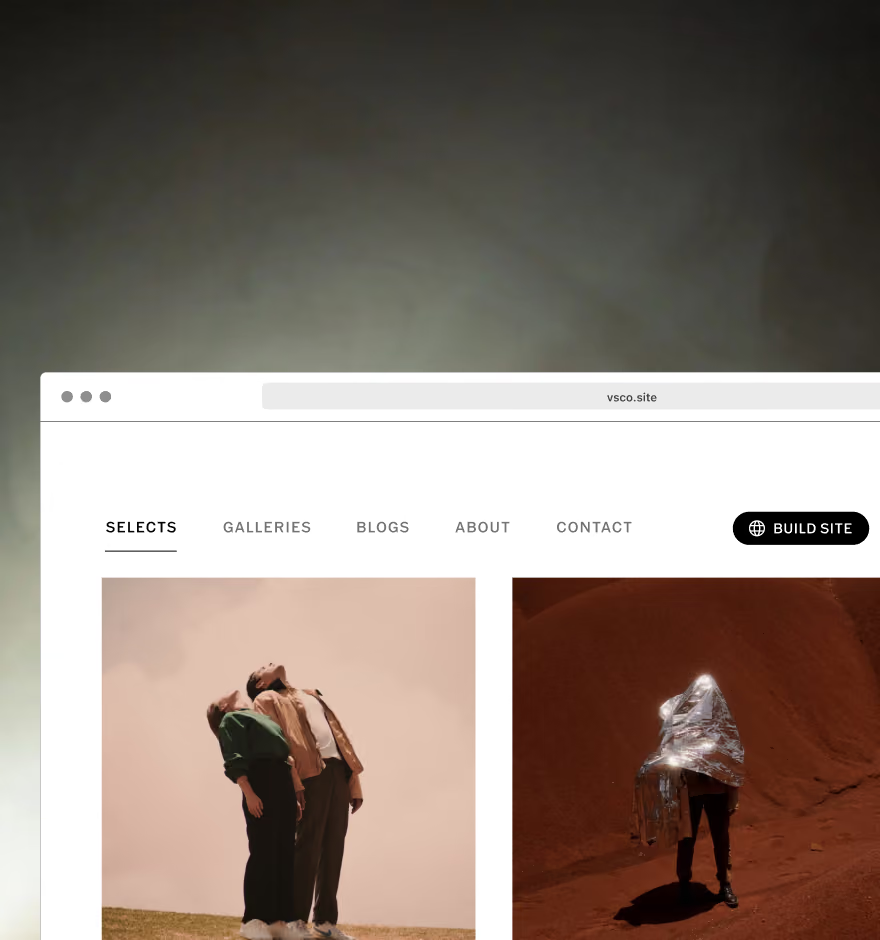
VSCO Sites builds a portfolio from your VSCO Profile, uploaded photos, Galleries, and Blogs with no code, and fast updates. Custom domain is included with Pro and One memberships.
The built-in contact form sends each inquiry to VSCO Workspace as a lead, and you can add fields such as project type, preferred dates or how the client found you.
You can also add public Galleries to your site to show projects in more depth.
Market Your Work Through Relationships and Outreach
Choose a few habits you can keep up instead of trying to be everywhere:
- Referrals: stay connected with past clients and make it easy for them to recommend you
- Direct outreach: contact brands, agencies, publications and businesses that align with your portfolio
- Professional relationships: connect with photographers, stylists, producers, designers and other creatives
- Social media: share finished projects, personal work and insight into your process
- Search visibility: use a professional website with clear service descriptions and your location
As photography becomes your primary income, put the administrative and legal foundations in place. Requirements vary by location and business structure, so consult qualified professionals. Common considerations include:
- Registering your business where required
- Opening a dedicated business bank account
- Setting up bookkeeping and expense tracking
- Creating contracts that define deliverables, payment terms, cancellations and usage rights
- Establishing invoicing and payment collection
- Obtaining appropriate liability and equipment insurance
- Consulting an accountant about taxes and financial planning
Pay particular attention to usage rights for commercial clients. Define where and how images can be used, the length of the license and whether exclusivity or added usage fees apply.
A scalable photography business isn't one that takes on more assignments. It delivers excellent work consistently without letting administration eat the time needed to create it. Think about the full life of an assignment:
- Inquiry and discovery call
- Brief, creative direction and mood board
- Quote, contract and retainer
- Scheduling and pre-production
- Session day and file backup
- Culling and editing
- Client gallery and delivery
- Final payment and follow-up
Standardize or template what repeats, such as contracts, questionnaires, reminders and delivery emails.
Keep personal what builds the relationship, such as the discovery conversation and your creative input. Learn more in our guide on how to automate client communication without losing the personal touch.
Plan Every Assignment
Confirm the brief, timeline, location, deliverables and budget.
For more involved assignments, create a shot list and gather references, then share them before the session so everyone understands the intended result.
In VSCO Canvas, you can build a mood board, share it view-only or editable, and let clients review and comment without a VSCO account.
New to Canvas? Here's how to get started with VSCO Canvas.

Organize Editing and Image Delivery
A consistent post-production process looks like this:
- Back up your original files
- Cull images and select the strongest photographs
- Edit and retouch the final selections
- Review for consistency and quality
- Prepare the final gallery and notify the client
- Complete outstanding payments and follow up
VSCO Galleries lets you deliver finished images through a link or QR code, and clients don't need an account or app to view them.
Schedule dedicated time for editing, delivery and admin, and use reusable checklists to keep deadlines in view.

Every inquiry, proposal, contract, payment, appointment and follow-up needs attention, and VSCO Workspace is built to hold them.
- Inquiries from your Sites contact form arrive as leads you can track from first contact through booking.
- A quote can bundle your packages, a questionnaire, a contract and a retainer payment behind one link and easy-access portal, with no client account needed.
- Contracts and invoices are reusable templates, invoices support deposits and installments, clients can book consults and sessions on your calendar, and automations can send questionnaires, contracts, invoices and follow-ups for you.
Full Workspace is included with VSCO One, and other memberships include a more limited set of Workspace tools.
You don't need to automate every step at once. Start with the tasks that take the most time or are easiest to overlook.
You don't have to wait until photography income fully replaces your paycheck to start preparing. Set milestones that show the business is becoming sustainable.
Before you make the switch, aim to:
- Show consistent demand and paid bookings
- Know your average booking value and monthly revenue requirement
- Build a savings cushion for slower periods
- Set pricing that covers your costs and income goals
- Create a repeatable way to attract and convert clients
- Put contracts, invoicing, bookkeeping and client workflows in place
- Understand your upcoming commitments and available cash
Test your model while you still have another income. You can raise your bookings, refine your services and build a cushion without depending on every new inquiry to pay your bills.
When you're ready, base the decision on the financial health and consistency of the business, not on how busy your calendar looks.
How do I become a full-time photographer?
Build your portfolio and a paid client base, set sustainable pricing and track your income and expenses. Save for slower periods and create repeatable workflows before photography becomes your primary income.
How much money should I save before becoming a full-time photographer?
A useful starting point is three to six months of essential personal and business expenses. Save more if your income is seasonal, your bookings fluctuate or you have significant financial responsibilities.
How do I know when to quit my job and become a full-time photographer?
Look for consistent paid demand, sustainable pricing, a reliable source of inquiries and a clear view of your financial needs. Your business should support your income requirements without relying on one busy month or a single large assignment.
How much should I charge as a professional photographer?
Base your pricing on your expenses, time, production costs, deliverables and desired income. Research your market and build packages, but calculate your own costs before using competitors' rates as a reference.
How much do full-time photographers make?
Income varies widely by specialty, market, business model and expenses, so there's no reliable single figure. Calculate your own revenue target from your personal needs, business costs, taxes and reserves.
How do I get more photography clients?
Build a portfolio that communicates your specialty, make it easy to contact you and develop consistent marketing habits. Referrals, direct outreach, professional relationships, social media and search visibility can all generate inquiries.
What do I need to start a photography business?
Typically a portfolio, a way to communicate with clients, equipment, editing software, contracts, invoicing and bookkeeping. Depending on your location, you may also need registration, insurance and tax arrangements.
How long does it take to become a full-time photographer?
There isn't a fixed timeline. It depends on your specialty, market, existing client base, pricing and finances, and many photographers build gradually while keeping another income.
Make Your Next Booking Your Turning Point
Moving from part-time to full-time photography takes time, and each step builds confidence in both your work and your business.
Your next step doesn't have to be leaving your job. It can be pricing your next assignment more sustainably, reaching out to a potential client or building a portfolio that reflects the work you want to do.